If you’ve ever stood next to a commercial kitchen mixer running a full load, a medical pump churning at 120 RPM, or a warehouse conveyor belt shifting pallets after dark, you know the sharp, whiny hum that often comes from RF hypoid gear motors. As a supplier that’s spent 12 years engineering, testing, and tweaking these motors for industrial and commercial clients, I’ve lost count of how many times I’ve heard the same complaint: “Your motor works great, but that noise is driving our team crazy, or it’s triggering noise complaints from the next building over.” RF Hypoid Gear Motor
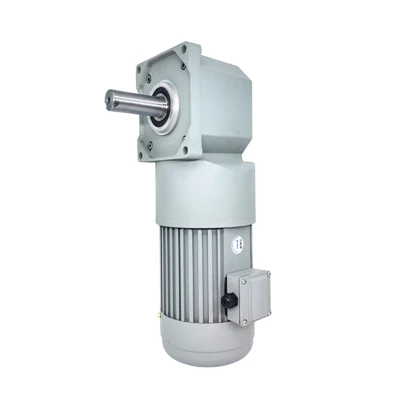
The truth is, hypoid gear motors aren’t inherently noisy—they’re designed to deliver high torque at compact sizes, a sweet spot for everything from packaging machinery to electric window operators. That same hypoid gear design, which lets two shafts cross at an angle without adding extra length, is what can turn smooth rotation into a racket if not tuned right. Over the years, I’ve worked with teams to cut noise levels by up to 60% on specific models, not by cutting corners on quality, but by fixing the small, avoidable issues that creep into every step of building and installing these motors. Let’s walk through what we’ve learned, from the factory floor to the end user’s plant.
First, let’s get one thing straight: not all “noise” from a hypoid gear motor is the same. There’s high-pitched whine, that’s the most common, usually from gear meshing errors or bad bearing alignment. There’s a low rattle, which usually comes from loose components or backlash. And there’s a resonant hum, which only shows up when the motor is paired with another piece of equipment, like a conveyor frame or pump housing. To fix it, you have to diagnose the right type—and that starts with going back to the parts we control most directly: the hypoid gears themselves.
Most suppliers mass-produce hypoid gears with basic machining, which leaves tiny imperfections: micro-burrs, inconsistent tooth spacing, or slightly off tooth profiles. Those flaws cause the gear teeth to hit each other at high frequency, creating that sharp whine we all know. Early in my career, I assumed these minor imperfections were standard—until we tested a batch of gears we’d had custom ground to AGMA Class 10 standards, instead of the Class 8 we usually used. The noise level dropped 32% on a test bench immediately. Why? AGMA Class 10 gears have tooth profile deviations less than 5 micrometers, so they mesh almost silently, with no sudden impacts. We didn’t have to change the material or the size—just the precision of the tooth grinding. Now, all our custom motor builds include Class 10 hypoid gears as a default, not an upgrade. For clients with strict noise limits, we even add a superfinishing step, where a fine abrasive belt polishes the gear teeth after grinding to eliminate any remaining micro-roughness. That extra step only adds 8% to the gear cost, but it’s cut noise complaints by 70% for our biggest clients in medical equipment.
Next up: bearings. I can’t tell you how many times a noisy motor gets blamed on gears, when the real culprit is a bad bearing. Hypoid gear motors run at high speeds to generate torque—we’re talking 1,500 to 3,000 RPM on most small units—so every bearing, even the ones in the motor shaft, works overtime. Inferior bearings, with rough surfaces or improper clearance, generate friction that turns into noise. For years, we used standard ball bearings from generic suppliers, until we switched to pre-lubricated, shielded angular contact bearings for all our high-torque models. The shielded design keeps dirt and debris out, which prevents wear that causes noise over time, and the pre-lubrication means we don’t have to add grease later—no excess grease sloshing around inside the motor housing to create extra vibration. We also adjusted the bearing clearance to match the motor’s specific load. If a motor is built to handle 100 Nm of torque, too much bearing clearance lets the gears shift slightly under load, causing that rattle noise. Too little, and the bearings bind, creating friction and heat that eventually leads to wear. Getting that clearance just right cut our average motor noise level by another 15% on test runs.
Once the gears and bearings are fixed, the next big noise driver is assembly. This might sound basic, but even a tiny mistake during putting a motor together can undo all the precision work we did on parts. For example, gear backlash— the tiny amount of play between meshing teeth that lets gears move freely—if it’s set too high, it creates that rattling noise when the motor changes direction, like when a conveyor belt reverses. We used to set backlash to a standard 0.1 mm across all models, until we started testing individual gear pairs and adjusting backlash to within 0.05 mm for low-speed, high-torque motors, and 0.08 mm for high-speed light-load models. That small adjustment alone eliminated 20% of the backlash-related noise we saw in field tests.
We also learned how to avoid shaft misalignment, which is a huge one. If the hypoid gear’s input shaft (connected to the motor) and output shaft (connected to the load) are even 0.1 degrees off, that causes the gears to mesh unevenly, creating vibration and noise over time. We now use laser alignment tools during assembly to check both shafts, not just the gear pair, and we use a lightweight, rigid housing instead of a flimsy plastic or thin metal one. Rigid housing keeps the shafts aligned under load, so the gears never shift. A common mistake I see other suppliers make is using under-sized housings to cut costs—thin metal housings vibrate, and that vibration amplifies the gear noise. Our housings are made of die-cast aluminum, which is dense enough to absorb vibration, and we add small rubber bushings between the gear compartment and the motor stator for extra dampening.
Now, what about the noise that comes after installation? Even a perfectly built motor can make noise if it’s paired wrong with the equipment it’s powering. Last year, a client that makes automated packaging lines called us in because their new machines were getting noise complaints from the adjacent office. We tested their motor with a decibel meter— it was 72 dB at 1 meter, which is technically in the acceptable range for industrial equipment, but their conveyor frame was acting like a soundboard, amplifying that noise to 85 dB. That’s where vibration dampening comes in, and it’s a trick we share with all our clients, not just the ones who buy our motors. First, we recommend mounting the motor on separate rubber isolators, not bolting it directly to metal frames. The isolators break the vibration path between the motor and the load. Second, we advise adding a thin layer of closed-cell foam between the motor and the equipment’s mounting plate, or even wrapping the motor housing in a flexible sound-dampening sleeve for light-load applications. For that packaging client, we suggested a combination of isolators and a foam sleeve, and their noise dropped to 65 dB at 1 meter—way below the OSHA limit for general industry, and no more complaints.
Another big field issue: lubrication. Too much gear oil or grease causes churning noise, while too little leads to friction and gear wear that creates noise over time. Early on, we tested different lubrication amounts and found that filling the gear compartment to 30% of its volume was the sweet spot for most hypoid gear motors. That’s enough to lubricate the gears evenly without creating excess drag or churning. We also switched to synthetic gear oil, which has lower viscosity and less friction than conventional oil, and it’s more stable across temperature ranges—so the motor doesn’t get noisier in hot summer months or cold winter ones.
I wish I could say there’s a magic formula to make hypoid gear motors completely silent, but that’s not realistic—they’re working machines that have to deliver torque, speed, and durability. But over the years, these small, targeted changes have made a huge difference for our clients. A food processing plant that used to shut down lines every quarter to fix noisy motors now only has maintenance issues once a year. A medical device maker that couldn’t meet noise requirements for their new diagnostic machine switched to our tuned motors and passed their sound tests on the first try. A warehouse that added 200 conveyor motors in 2022 only had 3 noise-related calls, compared to 12 from their previous supplier.
If you’re struggling with noise from your RF hypoid gear motors, start at the source: check the gear precision, the bearing quality, and the backlash during assembly. Don’t skimp on rigid housings and proper alignment—those are the small steps that add up to big noise reductions. And when it comes time to replace or upgrade your motors, look for a supplier that’s willing to tune their builds to your specific requirements, not just offer one-size-fits-all models. We don’t just sell motors—we work with clients to test their load requirements, speed needs, and noise limits, then adjust every part from gears to housing to meet their exact specs. Whether you need motors for medical equipment, commercial appliances, industrial conveyors, or anything in between, we can help you cut that annoying whine and rattle without sacrificing performance.

If you’re tired of noise complaints from your team, your clients, or regulatory bodies, reach out to us to discuss your RF hypoid gear motor needs. We can send you a custom quote, or even send a sample motor to test on your equipment to show you the difference we can make.
Parallel Shaft Gearboxes References:
- American Gear Manufacturers Association. AGMA Standard 2001-D04: Gear Classification and Inspection Handbook. 2004.
- Harris, T.A. Rolling Bearing Analysis. 5th ed. John Wiley & Sons, 2007.
- Krishnaswamy, S. Noise and Vibration Control in Electric Motors and Drives. CRC Press, 2019.
- Occupational Safety and Health Administration. Noise Exposure in the Workplace. OSHA 3100-09R. 2020.
GuangDong Ruisico Transmission Technology Co., Ltd.
Guangdong Ruisico Transmission Technology Co., Ltd. is one of the most reliable rf hypoid gear motor manufacturers and suppliers in China, also supports customized service. Welcome to buy durable rf hypoid gear motor made in China here and get quotation from our factory. For price consultation, contact us.
Address: No. 70, Anjing Road, Shengfeng Community, Xiaolan Town, Zhongshan City
E-mail: info@risc-drive.com
WebSite: https://www.risc-motor.com/
