Hey there, Cable Tray Roll Forming Line
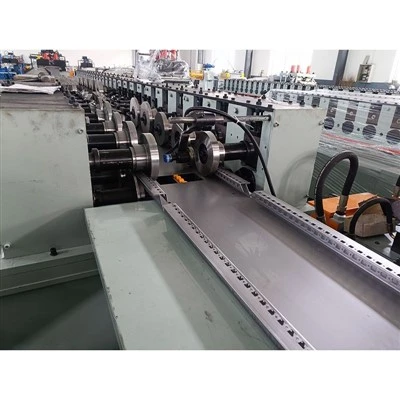
If you’re here because you’re shopping for a cable tray roll forming line (or already have one and are just trying to get a grasp on what it can actually pump out), you’ve probably stared at specs sheets that throw around numbers like “capacity” and “output” like they mean the same thing—spoiler: they don’t. I’m Jake, one of the sales guys here at the line manufacturing facility, and I field this question every single day. Folks always wanna know straight up: “What’s the production capacity of a cable tray roll forming line?” No fluff, no jargon. Let’s break it down like I would over a coffee at the shop floor.
First off, let’s kill the myth that capacity is just a big number. That’s a lie spread by guys who just type specs into a sheet without ever turning a wrench on one of these machines. Real capacity depends on way more than the machine itself. Let’s start with the core stuff: the roll former itself. Most standard lines we build run at a linear speed of 15 to 60 meters per minute (that’s 50 to 200 feet, for my US-based crew). But wait—speed on paper vs. real-world speed? If you’re running 150mm wide steel cable trays, that’s way different than 300mm wide, right? Wider material means each roll pass has to do more work, so you can’t crank the speed as high. Also, the gauge (thickness) of your steel matters. Thin, 0.8mm mild steel? You can blast that through at near top speed. Thick, 2.5mm galvanized steel? You gotta slow that way down to avoid warping the tray or straining the rollers. We usually say “average line speed” is 30 to 40 meters per minute for standard 1.2mm to 2.0mm steel, which is what most guys use for general cable runs.
Now, let’s do the math, but keep it realistic. I hate when someone does a 24/7 calculation and calls that capacity—who’s running a factory 24/7 without downtime? Nobody. Even the big boys do 8-12 hour shifts, 5 days a week, with 15-minute breaks every 2 hours, and maybe 2 hours of downtime a day for tool changes, coil swaps, or fixing a jam (those happen, don’t panic). So let’s stick to a real-world working week. Take that 35 meters per minute average speed. Let’s say you run 8 hours a shift, two shifts a day (16 total hours), 5 days a week. That’s 16 x 60 = 960 minutes a week, minus, let’s say, 3 hours of downtime total (jam, coil swap, tool change). So ~900 minutes of actual running time. Multiply that by 35 meters per minute, you get 31,500 meters a week. Wait, that’s 31.5 kilometers, or ~19.5 miles. But wait—we have to trim the trays, right? Every section of cable tray is a fixed length—usually 3 or 6 meters (10 or 20 feet) for shipping. So when the line is running, you’re not just rolling out continuous metal; you’re cutting it to length. That takes a couple seconds every cut, so that knocks off maybe 5-8% of that total. So now we’re at ~29,000 meters a week. That’s the sweet spot for a standard line, say for 100mm to 300mm wide trays.
But wait, what if you want bigger trays? Like 600mm wide, that’s common for big commercial buildings or data centers. Those lines run slower—like 18 to 25 meters per minute. So same 900 minutes of running time, 20 meters per minute average, that’s 18,000 meters a week, minus trim time, so ~16,500 meters. That makes sense—wider, stiffer trays need more careful forming, so slower speed, less total output. And if you’re running aluminum cable trays? Aluminum is softer, so you can go a bit faster than steel, maybe 5 to 10% higher speed, so that adds a little to your capacity, but not a ton, since aluminum is used more for light-duty, small trays anyway.
Now, here’s the part no one tells you: the capacity also depends on your upstream and downstream setup. You can have the fastest line in the world, but if your uncoiler (the machine that holds the steel coil and feeds it into the roll former) can’t handle a heavy coil without stopping every 10 minutes to swap it, that’s a bottleneck. We build uncoilers that can hold 5-ton coils, which means you can run a full 5-ton coil without swapping, which cuts downtime a lot. Also, your cut-to-length and stacking system—if you have a manual stacker, that’s gonna slow you down because someone’s gotta pick up each tray and stack it. If you have an automatic stacker that grabs each cut tray and stacks it in neat bundles, that frees up a worker and keeps the line running non-stop for longer. We always tell customers: don’t skimp on the ancillaries. They’ll boost your actual capacity more than a 10% faster roll former will.
Another big factor: the type of cable tray profile. We make lines for all kinds—straight perforated, solid, ladder-style, channel. Ladder trays have those side rails and rungs, right? So the roll passes have to make both the side and the rungs, which is an extra step, so that line runs 10-15% slower than a solid perforated tray line. So if you’re producing ladder trays, your capacity will be a bit lower than the numbers I gave earlier. That’s why when a customer first calls me and says “I need a line that makes X amount of trays a week,” I always ask three questions: what’s the width and gauge of your trays? What material are you using? What profile? Because those change everything.
Wait, let’s talk about maximum vs. practical capacity. The maximum theoretical capacity would be 24/7, no downtime, no trim time, at top speed. For a standard line, that’s like 80,000 meters a week. But that’s never gonna happen. Not because the machine can’t do it, but because no one can maintain that pace. Workers need breaks, coils need swapping, you have to change the profile if you’re switching sizes (even a quick profile change takes 15-20 minutes). Practical capacity is what matters. That’s the number you can actually hit consistently, week in and week out, without burning out your team or breaking the machine. For most of our standard lines, we quote practical capacity as 25,000 to 35,000 meters per week for small to medium solid trays, 15,000 to 20,000 for larger or ladder trays. That’s what our customers actually hit in their factories.
I’ve seen guys come in and say “I need 50,000 meters a week, so I need a line that does 60k.” But that’s overkill. You don’t need a line that’s running at 100% capacity every hour of every shift. You need a line that can handle your current order load and leave room for growth. If you plan on expanding your business next year, you can always crank the speed a bit (as long as your ancillaries can keep up) or add a second shift. But buying a line that’s way too big just because the spec sheet has a high number is a waste of money. We had a customer a couple years ago who bought a huge heavy-duty line because he thought “bigger is better,” but he was only making small 100mm solid trays. He ended up running it at 50% speed because he couldn’t find orders big enough to fill it. He came back a year later and traded it in for a smaller line that was a better fit. Don’t make that mistake.
Also, maintenance plays a role. If you’re servicing your line every month—lubricating the rollers, checking for worn parts, tightening bolts—your capacity stays consistent. If you skip maintenance, you’ll have more jams, broken rollers, and downtime, so your actual output drops. We always include a maintenance guide with every line, and our technicians do a follow-up call a month after installation to walk customers through it. It’s not rocket science, but it makes a huge difference.
Let’s wrap this up with a real example, because numbers are easier to grasp. Let’s say you’re a contractor in Dallas, making 150mm wide, 1.5mm galvanized steel perforated trays, running two 8-hour shifts a day, 5 days a week. No fancy profile changes, just standard 6-meter (20 foot) sections. Your line is our standard mid-range roll former, average speed 35 meters per minute, automatic uncoiler and stacker, minimal downtime. Let’s do the math again: 16 hours a day = 960 minutes. Minus 2 hours total for breaks, coil swap, a quick jam: 940 minutes. 940 x 35 = 32,900 meters. Minus trim time (about 7%): ~30,600 meters a week. That’s enough for, let’s say, 5,100 6-meter trays, or 10,200 3-meter trays. That’s a solid output for a small to mid-sized operation. You can adjust that if you go to one shift (half that, ~15k meters a week) or add aluminum (a little over 32k) or ladder trays (closer to 26k).
At the end of the day, the production capacity of a cable tray roll forming line isn’t a fixed number you can pull off a spec sheet. It’s a mix of the machine’s design, the material you use, the profile you’re making, and how you set up your factory floor (ancillaries, shifts, maintenance). We build lines tailored to what our customers actually need, not just to hit a big marketing number.
If you’re shopping around for a line and you’re not sure what capacity you really need, don’t waste time guessing. Hit us up to chat—we’ll ask you those key questions (tray size, material, profile, order volume) and help you figure out exactly what line is right for you. No pressure, no sales pitch that feels like a car dealership. Just straight talk about what works.

Thanks for hanging out,
Jake
Other Customized Equipment References
- "Roll Forming Capacity Calculations: A Practical Guide," International Journal of Manufacturing Technology, 2021.
- "Cable Tray Manufacturing: Equipment and Process Optimization," Industrial Production Magazine, 2022.
- "Real-World Output Metals for Roll Forming Lines," Modern Metal Fabrication Journal, 2023.
Weifang Yue Jun Machinery Co., Ltd.
With abundant experience, we are one of the most professional cable tray roll forming line manufacturers in China. We warmly welcome you to buy durable cable tray roll forming line made in China here from our factory. We also accept customized orders.
Address: Kuiwen District, Weifang City, Shandong Province
E-mail: adrian@yuejunmachinery.com
WebSite: https://www.yuejunmachinery.com/
