If you’ve ever walked past a processing plant handling bulk solids—like grain, plastic pellets, or powdered cement—you might have noticed a machine quietly moving material from one part of the line to another, without jamming, spilling, or wasting a single grain. That machine is often a rotary feeder, and one of its most critical functions is what we call a “drop through” design. As a supplier of industrial rotary feeders, I get asked all the time: “What exactly is a drop through rotary feeder, and why does it matter for my operation?” Today, I’m breaking this down plainly, from what it is to how it works, and why it’s a game-changer for bulk handling. Rotary Feeder
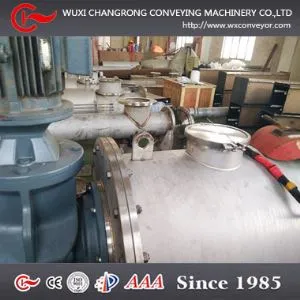
First, let’s start with the basics. A standard rotary feeder (sometimes called a rotary valve or airlock) is a cylindrical device with rotating vanes inside a housing. It connects two sections of a processing line—say, a hopper that holds raw material and a conveyor that moves it to a dryer or mixer. The vanes spin, picking up material from the inlet, carrying it through the housing, and dropping it out the outlet at a controlled rate. The “drop through” modifier refers to how that material exits the rotor: instead of being forced out against high pressure or tight tolerances, gravity pulls it straight through the gap between the rotor’s vanes and the housing into the outlet chute.
This might sound like a small design detail, but it’s the difference between a feeder that runs 24/7 without issues and one that clogs, leaks, or degrades your material. Let’s dive into the engineering behind it. In a drop through rotary feeder, the rotor’s vanes, housing, and outlet are aligned so that the bottom of each vane pocket opens directly to the outlet line as the rotor spins. There’s no squeeze point—no tight clearance that would compact material, especially fragile or lightweight stuff. For example, if you’re handling food-grade powdered sugar (which clings easily to surfaces), a drop through design lets the powder slide right out without caking inside the vanes. If you’re moving plastic resin pellets, which can crack under pressure, the gentle drop prevents breakage that would ruin your product.
Now, let’s address the most common questions I get as a supplier: How is it different from other rotary feeder designs? Some feeders are “pressure seal” designs, built to hold back high positive pressure (like in a pneumatic conveying line) or negative pressure (like in a vacuum system). Those require tighter clearances between the vanes and housing, sometimes as little as 0.1mm, to stop air from leaking through. That’s great for pressure applications, but it’s terrible for soft, fragile, or sticky materials—they get trapped in the small gaps, causing wear on the vanes and housing, and leading to feed rates that become inconsistent over time. A drop through rotary feeder, by contrast, has slightly larger clearances (usually 0.5mm to 1mm) and a more open bottom, so material doesn’t get trapped. It’s not built for extreme pressure, but it’s ideal for low-to-medium pressure or gravity-fed applications, which are the majority of bulk handling operations in agriculture, food processing, pharmaceuticals, and light manufacturing.
Wait, so is a drop through rotary feeder only for low-pressure use? Not exactly. Modern designs have adapted to bridge the gap. We’ve engineered drop through feeders with reinforced housings and balanced rotors that can handle up to 5 PSI of positive pressure, which is more than enough for many conveyors. The key is that the drop through action remains: material still exits via gravity, so even under low pressure, it doesn’t need to be pushed out. That reduces energy use too—since the rotor doesn’t have to work against pressure to move material. I’ve seen clients cut their feeder’s electricity costs by 15-20% just by switching from a pressure seal feeder to a drop through model for their mid-pressure lines.
Let’s talk about real-world applications, because that’s where this design shines. Take a local farm that handles soybeans: they used a standard pressure seal rotary feeder, and within six months, their vanes were wearing out, and their soybean breakage rate hit 8%—way above their 2% target. When they switched to our drop through rotary feeder, the breakage dropped to 1.5%, and vane life doubled. Why? The drop through design eliminated the compaction of soybeans in the vane pockets, which was causing both breakage and extra friction on the vanes. For a pharmaceutical client handling active pharmaceutical ingredients (APIs), contamination risk is non-negotiable. A drop through feeder has fewer dead spots (areas where material can get trapped) than a pressure seal design—so there’s no risk of old product sitting in the feeder and mixing with new batches, which is a huge compliance win for FDA-regulated operations.
Another big benefit: ease of maintenance. Drop through rotary feeders are simpler to take apart and clean. The open bottom means you can inspect the vanes and housing in minutes, no need to dismantle complex pressure-seal components. For food and pharma clients, that’s critical for meeting sanitation standards. Last year, one of our bakery clients told us that their cleaning time for the feeder went from 45 minutes to 10 minutes after switching to a drop through model, which saved them hours of labor each week. Of course, no design is perfect. A drop through rotary feeder isn’t the right choice for every application. If you’re handling dense materials like metal ore or cement in a high-pressure pneumatic conveying line, a pressure seal feeder will be more efficient at containing pressure and reducing air leakage. If you need precise, high-volume feed rates for mixing, some applications might benefit from a variable-speed pressure feeder instead. The key is matching the feeder design to your specific material and operating conditions.
As a supplier, I always tell clients to ask three questions when considering a drop through rotary feeder: What material am I handling? What’s the maximum pressure in my system? How often do I need to clean and maintain the equipment? If your material is fragile, sticky, or prone to caking, and your operating pressure is under 5 PSI, a drop through feeder is almost always the right call. We also offer customizations—like polished stainless steel housings for food/pharma, adjustable outlet chutes for alignment with your conveyor, and coated vanes to prevent material adhesion—to make sure the feeder fits your exact needs.

I’ve been working with rotary feeders for over 12 years, and the drop through design is one of the most underappreciated innovations in bulk handling. Too many operations rely on generic feeders without understanding how their design impacts product quality, maintenance costs, and efficiency. I’ve seen clients save thousands of dollars a year in product waste, labor, and energy just by choosing the right feeder design.
Bucket Elevator If you’re curious whether a drop through rotary feeder is right for your operation, or if you’re ready to replace a worn-out feeder, we’re here to help. We work with operations of all sizes, from small local farms to large manufacturing plants, to design and install feeders that meet their specific needs. Reach out to our team to discuss your bulk handling challenges and find a solution that works for you.
References
- The American Society of Agricultural and Biological Engineers (ASABE). "Rotary Valves for Bulk Material Handling," 2021.
- Food and Drug Administration (FDA). "Sanitation Design for Food Processing Equipment," 2020.
- Bulk Solids Handling Magazine. "Key Design Considerations for Rotary Feeders," Volume 40, Issue 2, 2019.
- National Institute for Occupational Safety and Health (NIOSH). "Reducing Breakage in Bulk Material Handling," 2018.
Wuxi Changrong Conveying Machinery Co., Ltd.
Wuxi Changrong Conveying Machinery Co., Ltd. is one of the most professional rotary feeder manufacturers and suppliers in China. Welcome to get custom rotary feeder from our factory. For price consultation, contact us now.
Address: Jiang Industrial Zone, Qianzhou Town, Huishan District, Wuxi Jiangsu Province
E-mail: changrong@changrong-jx.com
WebSite: https://www.wxconveyor.com/
