Hey there, if you’ve ever dabbled in parts for machinery—whether you’re a seasoned maintenance tech, a startup design geek, or just someone replacing a part in a garage—you’ve probably heard someone toss around "flanged ball bearing" like it’s basic lingo. But let’s be real: unless you live and breathe bearings, it’s easy to glaze over that term and not get why it’s way different from the random ball bearing you grabbed from the hardware store bin. As a flanged bearings supplier, I’ve spent years walking people through this, so let’s break it down like we’re geeking out over a machine part, no stuffy jargon allowed. Flanged Bearings
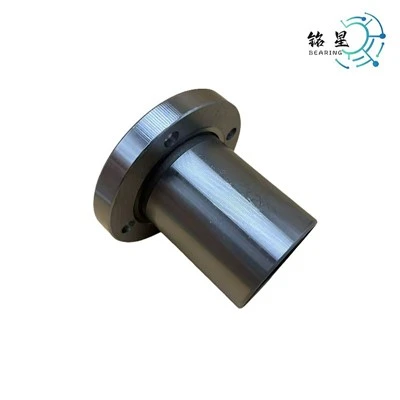
First off, let’s start with the basics of regular ball bearings, because that’s the foundation. A standard ball bearing is like a tiny, super smooth team: you’ve got an inner ring, an outer ring, a bunch of hard metal balls rolling between ’em, and a cage to keep the balls from clacking into each other. Their whole job? Let two parts spin smoothly without rubbing, cut down friction so things don’t burn out fast, and handle the loads (weight or force pushing on the bearing) from whatever machine they’re in. Now, the flanged part is the game-changer here. Imagine taking that standard outer ring and gluing (well, engineering—way sturdier than glue) a flat, round rim straight out of its edge. That rim’s the flange. It sounds simple, but that tiny addition fixes a headache almost every machine builder has.
Wait, let’s make that relatable. Think about when you’re building a small conveyor for a warehouse, or a backyard workshop’s drill press, or even a medical device spinning sample tubes. You need the bearing to sit exactly where it’s supposed to, right? If you use a regular ball bearing, you have to cut a special groove in the housing it sits in, or add extra hardware like clips or bolts to stop it from sliding sideways. That’s extra work, more parts to lose, more stuff that can break. The flange eliminates all that. It’s like the bearing has its own built-in "stake" that locks it right into place. No fancy machining, no extra assembly steps. That’s why flanged ball bearings aren’t just a variant—they’re a solution to a super common problem.
Now, let’s get into why this matters for different uses, because not all flanged bearings are created equal. I’ve seen guys grab a $5 flanged bearing for a food processing line that shouldn’t rust, then wonder why it corroded in a month. Or a guy use a cheap plastic-flanged bearing for a heavy conveyor, and it cracked after a week. That’s where specs come in, and yeah, I’ve ranted to a few customers about this over coffee (or Zoom, these days—no in-person coffee, sad!) because skimping on flange material or bearing quality kills projects.
Let’s split flanged ball bearings into the main types so you don’t get overwhelmed. First, there’s the metric ones—super common in European and industrial machinery, used for things like pumps, small motors, and automotive parts. I sell metric flanged bearings all day long; they come in sizes from tiny (like 6mm inner diameter for a tiny robotics arm) up to, well, not tiny. Then there’s inch-sized, mostly for US-made equipment, garage projects, or older machinery that’s tricky to find parts for. Some flanges are pressed-on (they’re stamped right onto the outer ring) and some are integral (they’re machined from the same piece as the outer ring, way stronger). Oh, and one big thing: flanges can be on one side or both. If you need the bearing locked in two directions? Double flange is your friend.
Loads are another big one. Ball bearings handle radial loads (that’s the force pushing out, like the weight of a fan blade spinning) and thrust loads (the force pushing along the shaft, like when you push a power tool forward). Flanged bearings are really good at thrust loads—like, way better than standard ball bearings, because that flange is catching that sideways force. I had a customer last month building a linear actuator for a factory robot; they were using standard bearings and the shaft kept shifting side to side, throwing off the robot’s grip. Switched to a flanged bearing, and the problem was gone in a week. No more adjusting the housing every shift.
Another underrated thing about flanged ball bearings: they make assembly way faster, which saves money. Time is money, right? If a machine line is down because a bearing is taking an hour to install, that’s lost profit. With a flanged bearing, you just drop it into the housing and it’s locked. Even for small parts—like a toy robot, or a camera gimbal—you don’t have to machine a retainer. I’ve worked with a few small robotics startups that swear by flanged bearings for their prototypes; it cuts their build time by 20% easy.
Now, let’s talk about when you should pick a flanged ball bearing over a standard one, because it’s not a one-size-fits-all. If you’re building something where side movement is a no-go, use flanged. If you need to mount it to a flat surface without extra brackets, flanged. If you’re working with tight spaces where adding extra parts is impossible? Flanged. But if your machine has a housing that’s already got a groove to lock a regular bearing, and you don’t need side load support, then a standard bearing will work just fine—no need to overcomplicate it.
I’ve also seen people confuse flanged ball bearings with other flanged bearings, like flanged roller bearings. No, ball bearings are for lighter to medium loads, super smooth spins, and high speeds. Roller bearings are for heavy loads, like big trucks or construction equipment, but they’re not as smooth. So if you’re working on a high-speed fan, a small motor, a drone gimbal, or a medical device, you want ball bearings with a flange. If you’re moving 10-ton loads, you need rollers. That’s the line I always help folks clarify, because mixing those up is a costly mistake.
Common mistakes I see? People grabbing the first flanged bearing they see online without checking the bore size (that’s the hole in the inner ring where the shaft goes) or the flange diameter. A lot of guys just measure the shaft size and order, but forget the flange has to fit into the housing slot. Another mistake is not checking the material: for outdoor or wet uses, like a pool pump or a farm irrigation system, you need stainless steel flanged bearings. For high-temperature uses, like an oven conveyor, you need bearings with heat-resistant seals. I once had a customer try a regular steel flanged bearing for a bakery dough mixer—salt in the dough corroded the bearing in 2 weeks, and they had to shut down their shift. Switched to stainless steel, and it’s been going strong for 6 months now. That’s why I always ask customers a million questions: what’s the machine used for? Environment? Speed? Loads? I don’t want someone ordering a part that’s gonna break on them.
As a flanged bearings supplier, one thing I pride myself on is being able to recommend the right bearing, not just sell whatever’s in stock. I’ve been doing this for 8 years, and I’ve helped so many small businesses avoid costly mistakes. Like the time a guy building custom bicycles needed flanged bearings for his custom wheel hubs—he thought he needed a specific metric size, but I showed him an inch-sized that fit better and was cheaper, and he saved $200 on his first order. Those little wins are why I love this job.
Wait, let’s also touch on seals, because that’s another big part of how a flanged bearing works. Some flanged bearings are open, no seals—good for places where you can lubricate it regularly, like a conveyor that’s easy to get to. Others have rubber or metal seals on one or both sides, to keep dirt, dust, water, or grease out. Sealed flanged bearings are perfect for places that are hard to reach, like a small motor in a washing machine, or a drone part. No need to lubricate them every month, which saves time.
So to wrap this up, let’s recap what a flanged ball bearing is, in plain terms: it’s a regular ball bearing with a built-in flat rim (flange) that locks it into place, cuts down on assembly time, handles side loads way better than a standard bearing, and comes in all kinds of sizes and materials for every use. It’s not just a fancy version of a ball bearing—it’s a tool that solves specific problems that standard bearings can’t.

If you’re working on a project, whether it’s a tiny personal build or a big industrial line, and you’re not sure if a flanged ball bearing is what you need, or you just can’t find the right size or material, hit me up. I’ve got all kinds of flanged bearings in stock, can help you pick the right one for your job, and answer any dumb questions (trust me, I’ve heard them all). No sales pitch, no hassle, just good advice.
Stainless Steel Bearings References:
- Shigley, J. E., & Mischke, C. R. (2001). Standard Handbook of Machine Design (2nd ed.). McGraw-Hill.
- SKF Group. (2023). Ball Bearings: Types and Applications. Technical Guide for Rolling Bearings.
- American Bearing Manufacturers Association (ABMA). (2022). Standards for Radial Ball Bearings.
- NTN Corporation. (2021). Flanged Ball Bearings: Design and Usage Guidelines. Industrial Components Catalog.
Taizhou Mingxing Bearing Co., Ltd.
As one of the most experienced flanged bearings manufacturers and suppliers in China, we warmly welcome you to wholesale durable flanged bearings in stock here from our factory. All customized bearings are with high quality and competitive price. For quotation, contact us now.
Address: No.168 Tonghe East Road, Luotuo Subdistrict, Zhenhai District, Ningbo City, Zhejiang Province
E-mail: qpj16888@outlook.com
WebSite: https://www.mingxingbearing.com/
